- Hawaiʻi Hotel Hui Insider
- Posts
- Exploding Grills, Wyndham Tiptoes onto Kauaʻi, and a Resort Fee Ban That Wasn’t
Exploding Grills, Wyndham Tiptoes onto Kauaʻi, and a Resort Fee Ban That Wasn’t

Aloha!
We are officially settling into the rhythm of 2026, and if the inbox is any indication, the industry is already moving fast. The feedback on the last few issues has been incredible! Mahalo to everyone who has taken the time to read, reply, and challenge us. It’s exactly why we built this Hui.
A big mahalo as well to our quarterly title sponsor, Allana Buick & Bers (ABB). We talk a lot about "guest experience" in this industry, but nothing kills a guest experience faster than a broken chiller or a pipe burst in the lobby. ABB are the pros who keep that from happening. They specialize in the critical side of hotel ownership: mechanical and HVAC CAPEX. Instead of waiting for a crisis, they help owners assess, plan, and engineer fixes before the panic sets in.
In this issue: Wyndham Hotels tiptoes onto Kauaʻi, condo-hotel liability blows up in a very real and very litigious way, and we ask the obvious question about the Green Fee: Where’s the actual plan? We also break down what 2025’s numbers are really telling us, why New York’s so-called “junk fee ban” is mostly political theater, and a hotel tech rebrand that is signaling a new standalone chapter for a very familiar platform.
If you find this useful, please forward it to a friend or colleague. We are building this community one reader at a time.
New here? Join the hui below. It’s free.
Mahalo for sticking with us!
Let’s dive in.
Mahalo,

Dan Wacksman
Hawaiʻi Hotel Hui Insider Editor-in-Chief 😄

Wyndham Quietly Grows on Kaua’i
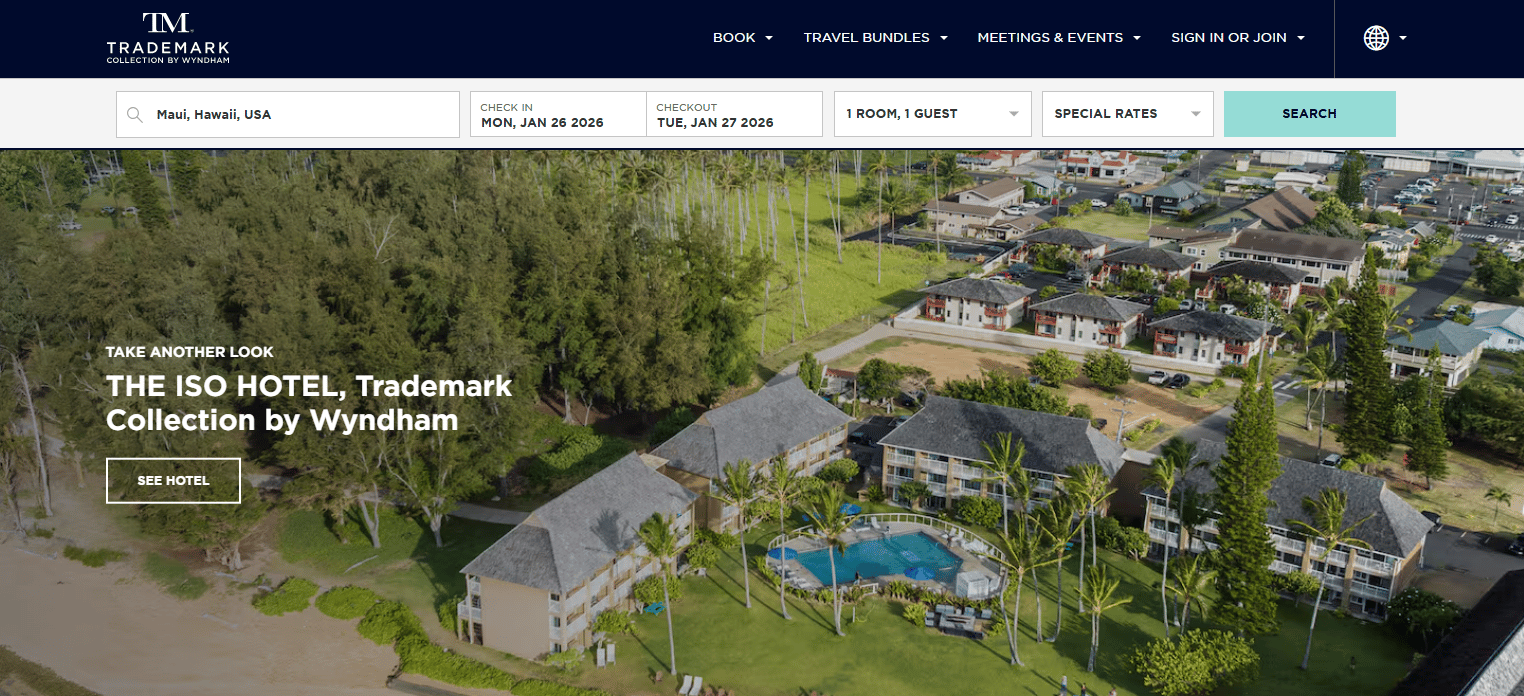
When Castle Resorts managed Hilo Hawaiian, which joined Wyndham’s Trademark Collection last year, it felt like a one-off. A soft brand landing on the Big Island, modest distribution upside, nothing seismic (Kilauea pun intended). But it turns out that may have been the opening move.
Castle has quietly added another one of its managed properties to the Wyndham Trademark Collection, The ISO (Island, Sky, Ocean). This is the first Wyndham hotel on Kauai. This does not include the 5 Kauai Wyndham Vacation Ownership inventory on Kauai, which, as we’ve noted before, is a separate publicly traded company, though it can be booked on the Wyndham website.
Wyndham’s hotel presence in Hawaiʻi has always been light, especially compared to its sizable timeshare portfolio. Trademark Collection (a soft brand) offers a low-friction way in: keep the property’s identity, plug into Wyndham’s distribution and loyalty engine, and avoid the heavy brand standards that can be tough to justify.
For Castle, this looks like a pragmatic play, distribution without reinvention. For Wyndham, it’s another small step toward relevance in the Hawai’i market.
When Liability Explodes: The Messy Reality of Condo Management

We’ve spent a lot of time lately deconstructing the “who’s on first” puzzle of Hawaiʻi hotel ownership, branding, and management. From trusts that own the dirt to brands that don’t actually run the building. But if you think hotels are complicated, step into the world of condotels and vacation rentals, where a single property can involve multiple layers. That complexity turned very real and very litigious after last year’s horrific grill explosion at The Whaler on Kāʻanapali Beach, which injured more than a dozen people.
The resulting lawsuit reads like a masterclass in impleading, a legal term for suing everyone tied to the property. Plaintiffs have filed negligence and liability claims against the AOAO, Aqua-Aston, Marriott Vacations Worldwide, HEI Hotels & Resorts, Destination Maui, Inc., along with equipment manufacturers and the gas company. The allegation is that the “resort” failed to implement basic safety protocols. But zoom out, and the broader issue is hard to ignore: who actually is the “Resort”?
When a guest books a stay at a “branded” vacation rental, they reasonably assume a single entity is responsible. In reality, responsibility is spread across a tangled web of ownership structures, management agreements, and vendors that only becomes visible after something goes wrong.
Reality Check: Most condo properties with significant vacation rental activity involve multiple parties, since individual owners usually control how their units are rented. Those roles are often blurred, but here’s how they typically break down.
Association of Apartment Owners (AOAO): The condo owners’ association that controls common areas, building systems, and shared operations.
Front Desk / Common Area Operator: A company hired by the AOAO to operate the front desk, typically a management company that also markets and may brand the property. These operators often run their own on-site rental pool, and in some cases even own the front desk and some common areas outright. (In this case, HEI Hotels and Resorts)
Branded Management Companies: Brand-affiliated operators that manage and market multiple units in a property for unit owners. (In this case, AquaAston and Marriott Vacations are examples).
Unbranded Management Companies: Independent companies that manage and rent units on behalf of owners without a brand. (Think local real estate companies and small management companies).
Self-Managed Units: Owners who operate and market their units directly, typically via Airbnb or VRBO.
I am exhausted just writing that, and that’s the simple version. The real one requires a whiteboard, a few lawyers, and a stiff drink
Experience the New Standard of Hotel PMS
-Sponsored-

Less complexity. More control. Stayntouch PMS is a cloud-based property management system built to streamline hotel ops without the usual tech headaches.
Why hotels are switching:
Save up to 80 hours a month by reducing manual tasks with intuitive workflows and built-in automation.
Manage multi-property portfolios up to 70% faster with real-time visibility and control across locations from a single platform.
Train new staff in under two days, so onboarding is faster, and consistency is easier to maintain, even with lean teams.
Stay flexible and mobile, with a system that adapts to how your hotel operates.
Easy to use, built for operators, and focused on keeping teams efficient while delivering exceptional guest experiences.
Sue Kanoho Stepping Down After Three Decades

I had the chance to attend HVCB’s annual membership meeting last week at the Royal Hawaiian Hotel, which covered market updates, the new “Hawaiʻi Stays With You” campaign, and changes to the HVCB management structure. It was a solid, informative session and, as always, great to reconnect with industry friends old and new.
A special and well-earned mahalo was given to Sue Kanoho, who is retiring after 29 years as Managing Director of Island Chapters and Executive Director of the Kauaʻi Visitors Bureau. Sue was sent off in style with a Proclamation from Governor Green and heartfelt words recognizing her lasting impact on Kauaʻi and Hawaiʻi’s visitor industry.
Mahalo nui loa, Sue, for all you have done for Kauaʻi and Hawaiʻi’s visitor industry. Wishing you all the best in your next chapter.
Green Fee: Still Waiting for the Plan
We’ve written before about the state’s new “green fee,” a 0.75 percent TAT increase projected to raise about $100 million a year and push Hawaiʻi’s tourism taxes to among the highest in the country. The pitch was clear: climate resilience, environmental protection, and more sustainable tourism. The concern was just as clear: whether the money actually stays dedicated, or eventually drifts into the general fund.
That question came up again in a recent NPR interview with Jeff Mikulina, chair of the Green Fee Advisory Council. According to Mikulina, the council reviewed more than 600 project proposals totaling over $2 billion in requests and has now sent a first-year funding portfolio to the governor. The focus is on ready-to-go projects with visible impact, particularly around wildfire mitigation, climate risk, and heavily impacted areas.
All of that sounds right. Hawaiʻi has heard similar promises before. Dedicated funds tend to be “dedicated” until budgets get tight. Cruise ship contributions are still tied up in court, federal funding has been pulled back, the Hawaiʻi economy is staring at a softer 2026, and the temptation to repurpose dollars never really goes away.
The green fee may be the right idea. But the real test is whether residents can actually point to meaningful projects and say, “That’s where the money went.”
Hotel Performance
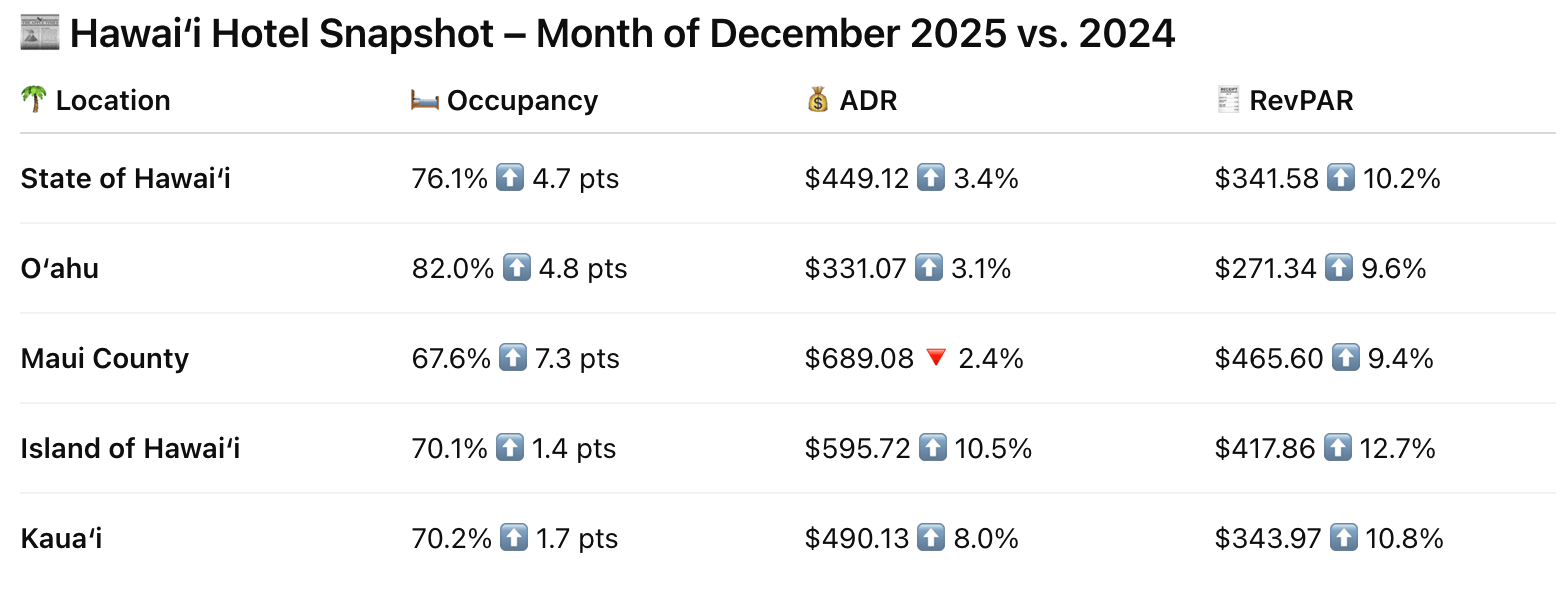

Hotel performance data will be published in the first issue of each month.

Resort Fees Banned! - Don’t Believe the Headlines… Except Ours.

New York City Mayor Zohran Mamdani made headlines a couple of weeks ago by “banning” resort fees and junk fees. Look past the headline, and it is really no more than a PR event than a meaningful policy shift. To be clear, the new rule does not ban these fees. It simply requires that the total cost be disclosed upfront.
That requirement already exists. The FTC rule now in effect requires hotels to display total prices clearly, and most operators have been complying since earlier this year. In that sense, New York is largely reinforcing a federal standard rather than breaking new ground.
The real story here is time. Resort fees are not banned, but their days may be numbered. Once fees are fully baked into the advertised price everywhere, the economic advantage fades fast. No hidden margin. No OTA arbitrage. No “looks cheaper until checkout” trick.
So no, resort fees didn’t die this week. But the clock is clearly running. And like many bad industry habits, they probably won’t disappear in a dramatic headline moment. They’ll quietly wither away once they stop working, or morph into something else. Attribution-based selling, anyone?
I’ve written before about booking fees and why they’re a problem. You can read that here.
It’s time to go all-in on direct.
-Sponsored-

When destination resorts package with air, they can offer more competitive pricing, giving travelers another reason to book direct. Tambourine is helping hoteliers bring the convenience of “one-stop shopping” to hotel websites without handing the relationship (or margin) to an OTA.
Create an OTA experience on your hotel site, smooth shopping, fewer clicks, less friction
Offer a lower overall price through bundled air + stay
Less than 5% cancellation on packaged bookings (because people commit when flights are involved)
2025 Was a Step Back. 2026 Looks Like a Grind

For the first time since 2020, U.S. hotel performance moved backward. CoStar’s final 2025 data shows occupancy down 1.2 percent to 62.3 percent and RevPAR slipping 0.3 percent. ADR rose slightly, but mostly just enough to keep up with inflation.
This slowdown was telegraphed months ago. CoStar, Tourism Economics, and PwC all downgraded their outlooks, and 2026 isn’t shaping up as a rebound year. Supply is growing faster than demand, costs remain elevated, and margins are tightening. Growth now has to be earned.
The market split is widening. New York City continues to outperform with strong rate-driven growth. San Francisco is finally showing life after a long recovery. Las Vegas, meanwhile, saw ADR drop 4.3 percent and RevPAR fall nearly 11 percent. Hawaiʻi landed somewhere in the middle: 2025 ended with modest statewide gains, with occupancy up slightly to 73.9 percent and RevPAR higher by 1.5 percent. Performance remained uneven across islands, as Oʻahu's RevPAR softened by 1.3 percent while Maui, the Island of Hawaiʻi, and Kauaʻi all saw gains, led by a 7.5 percent RevPAR jump on the Big Island.
Add some macro noise, and the picture gets shakier. A 43-day federal government shutdown in late 2025 wiped out more than $1 billion in hotel revenue. And with the 2026 World Cup approaching, even the talk of a potential boycott tied to geopolitical tensions is a reminder of how fragile international demand can be. So much for mega-events being a silver bullet, even after a FIFA “peace prize.”

New Logo, New Name, Same Synxis

As we reported earlier, Sabre Hospitality was carved out from Sabre Corporation and sold, temporarily living under the placeholder name “Hospitality Solutions.” Last week, it finally got its permanent rebrand: Aven Hospitality.
I’ll admit, I was quietly rooting for a return to something closer to its roots. SynXis, for all its quirks, is still one of the most recognizable core platforms in hotel tech. But alas, leave it to us clever marketing folks to decide the future is best signaled with a brand-new name that means… something aspirational?
New email domain, new community portal, renamed products, and a rebranded learning platform are all part of the Sabre separation. URLs stay the same, but plenty of back-end plumbing is getting reworked.
New name. New logo. Same mission. The real test isn’t the rebrand. It’s what they ship next. If you are a user of the company formerly known as Sabre Hospitality, some good information can be found here.
Digital marketing bumming you out?
-Sponsored-

Digital marketing can be a headache, even the experts at Talk Agency agree.
But the topline revenue growth and bottom-line profit improvement you can get from it definitely do not suck, especially in a soft market.
The problem isn’t your dislike for digital marketing. Its lack of a clear, easy-to-implement strategy and a closed tracking loop that clearly shows MoM improvement, as well as what is and isn’t working.
Talk Agency is ready to roll up their sleeves and dig into your business to build an action plan that delivers results, not promises.
Book your free digital marketing clarity workshop with our founder, Cooper Jitts, to unlock new growth today.

Industry Events
Help celebrate the relaunch of Hawaii.com
-Sponsored-
The team behind Hawaii.com is hosting an evening of food and cocktails to celebrate their recent relaunch. Learn more about their vision as they continue building a trusted platform for travelers and local partners.
Date: Thursday, February 26th |  |
Space is limited; if capacity is reached, you will be added to a waitlist and kept informed as the event approaches.
PATA 2026 Annual Outlook & Economic Forecast Forum - February 6, 2026 (Oahu)
HLTA 2026 Na Po‘e Pa‘ahana Awards – February 11, 2026 (Oahu)
The Hospitality Show (AHLA and HHA) - February 12, 2026
*If you have industry events to share, please email me at [email protected].

Spotlight on Hawai‘i Hospitality Opportunities
Hotel Assistant Manager - Prince Waikiki (Honolulu)
Director of Revenue Management - Renaissance Honolulu (Honolulu)
Vice President, Operations The Americas - OUTRIGGER Hospitality Group (Honolulu)
Area Marketing Manager - OUTRIGGER Hospitality Group (Kailua-Kona)
Vice President, Hawaii Revenue Strategy - OUTRIGGER Hospitality Group (Honolulu)
*If you happen to have any job openings, let us know. We will be glad to include them in the newsletter, space permitting; send the job link to [email protected].

The inbox was active this week, which is exactly what we want. This newsletter is meant to be a conversation, not a monologue, and the Hui definitely had plenty to say, especially regarding the shift in tourism messaging.
We love the feedback, whether it’s a pat on the back or a reality check. Here is what you had to say.
Praise from the Peanut Gallery
“Loving your Hawaiʻi Hotel Hui emails! Mahalo nui for the insight and mana'o.”
“Nice newsletter! I've just forwarded [to] brand partnerships.”
“Good job on this newsletter. Very informative and great in sharing about NYC, Waikiki, and AI trends... Agree messaging is better, moving away from the teaching to what Hawaiʻi is.”
Editor’s Note: Mahalo for the forwards. It is the highest compliment we can get (and helps us keep the lights on).
The HTA / HVCB Messaging Debate
“As for the messaging and Japan communications, I bet Malama did not encourage one Japanese visitor to come or return to Hawaiʻi.”
“The message isn’t ‘finally right’... It’s right for the current time. It shifted to themes like Mālama in 2021 when the first wave of tourists was arriving post-pandemic. Many were coming in with the wrong mindset... People needed to be invited to experience Hawaiʻi from that mindset... Is it time for something new? Sure, but it doesn’t mean that wasn’t right five years ago.”
“I wouldn’t say ‘the message is finally right’ because it might imply that the previous message was wrong, which, in my opinion, is not wrong. Maybe from a marketing perspective it was, but it was what Hawaiʻi needed at that time, especially Maui.”
On Development & Closures
“Another iconic business closing [Paradise Cove]... soon only memories will remain of these institutions that shaped the experience for residents and visitors alike in the 1980s and 1990s.”
“I am a bit concerned ... for sure it will affect Maui’s economy ... I used to work with a Real Estate developer on Maui with a mission to provide affordable homes... until they had to let us all go because we were not able to get the approval on the last proposed affordable housing subdivision. It’s not simple... it’s all quite complicated... so many things to consider...”
“Maui seems a little bit busier… but it’s high season, so it’s usually busier… It’s hard to tell, but praying we are on our way to recovery.”
Agree? Disagree? Have a hot take on the "Green Fee" rollout? Fire back at [email protected]. We read every single one.

About Us
Hawaiʻi Hotel Hui was started by hotel industry veteran Dan Wacksman, CEO of Sassato, a Hawaiʻi-based consultancy that combines deep local expertise with a global perspective.
Our team brings decades of experience across operations, marketing, revenue, tech, and finance, all aimed at helping hotels and travel companies make smarter decisions and move faster. Whether you need additional expertise, extra horsepower, or just someone who thinks like you and moves things forward, we’ve got you. From local independents to global brands, we show up with a no-nonsense, results-focused mindset. To be blunt: we get sh*t done.
Recent projects include brand transitions, system selection (PMS, CRS, CMS — all the acronym soup), implementations, project management, feasibility studies, training, audits, and everything in between.
A lot of organizations deal with stretched teams, siloed processes, and messy tech stacks that quietly stall important work. We fix that. Happy to chat if this hits close to home.